
Introduction
Many people believe that surfing is purely a test of physical balance and strength. While a strong core and good paddling posture are essential, the real secret to becoming a great surfer lies in a mental skill: the art of reading the ocean. Surfing is a dynamic dance with nature, and understanding how waves form, break, and travel is what separates a beginner from a true advanced rider.
Mastering Wave Selection
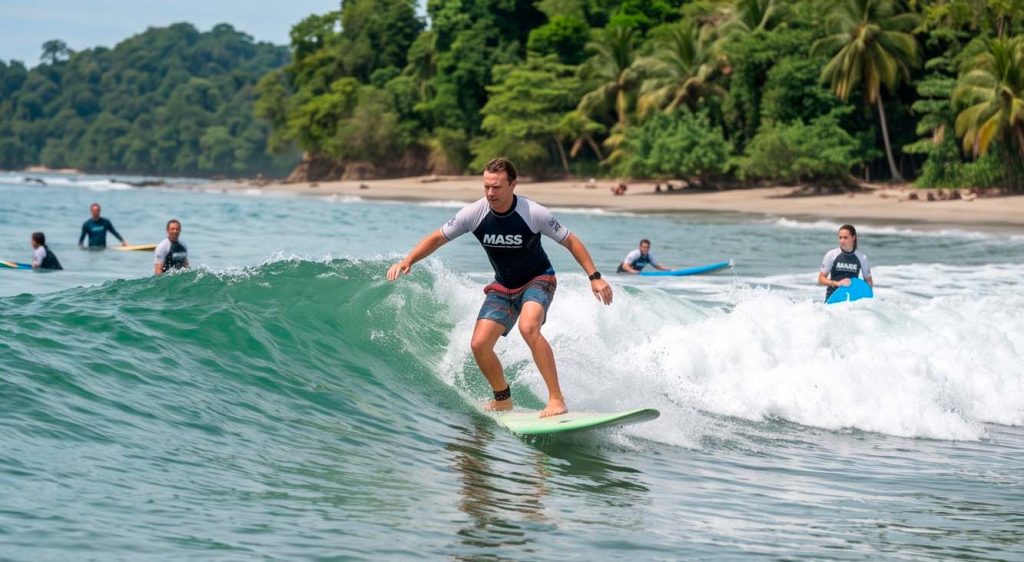
Every single wave is unique, shaped by factors like wind, tide, underwater topography, and swell direction. Learning wave selection means being able to look at the horizon, identify which wave has the best shape, and predict exactly where it will break. At Manuel Antonio Surf School, we emphasize this skill from day one. Instead of just paddling for any piece of moving water, you learn to identify the “pocket” of the wave—the area where the wave’s energy is concentrated—giving you maximum power for your ride.
Speed Control and Positioning
Once you are up on your board, the challenge shifts to speed control. You must understand how to accelerate to make it past a closing section, and how to decelerate to stay near the power source of the wave. By using foundational dry-land training tools like balance boards and pool technique sessions, surfers can lock in the correct hip and shoulder positioning before ever touching the saltwater. This precise alignment allows you to execute fluid carves, powerful turns, and simple tricks like floaters with total, effortless control.